The Periodic Table of Time and Transformation
The 64 hexagrams of the I Ching are like the Periodic Table of the Elements but instead of matter, they map every state of existence, transformation, and change. Here is how the whole system builds from a single binary bit.
Imagine someone handed you a table, not of chemical elements, but of situations. Every situation a person can find themselves in. Every turning point, every transition, every moment of growth or decay. Not a periodic table of matter, but a periodic table of fate. That is the I Ching.
The I Ching, or Book of Changes, is one of humanity's oldest texts, a Chinese oracle and philosophical system at least three thousand years old. But underneath its ancient shroud is something startlingly modern: a complete binary classification system built from the ground up, two states at a time.
Chemists have the Periodic Table to navigate matter. The I Ching offers its own table, not of atoms, but of moments. Sixty-four moments. Every cycle of creation, growth, peak, decline, and renewal that we pass through.
Level 1
1 Bit, 2 States: Yin & Yang
Everything begins with this question: is this moment open or closed? Receptive or assertive? Dark or bright?
Before numbers, before words, the I Ching observed that all of reality seems to pulse between two opposite poles. Light and shadow. Full and empty. Activity and rest. The ancient sages gave these poles names: Yang - the solid, active, bright principle and Yin - the open, receptive, dark principle.
These states were represented by these lines:
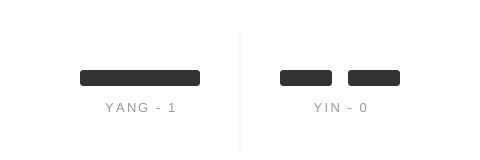
The two primal states: one solid line (Yang) and one broken line (Yin)
Think of it like a single binary digit. A 1 or a 0. On or off. This is the seed from which the entire system grows.
However, the I Ching does not treat Yin and Yang as opposing enemies. They are complementary. Each contains the seed of the other — just as the yin-yang symbol shows a dot of light within the dark, and a dot of dark within the light. There is no absolute: everything is in relationship, everything is in motion.
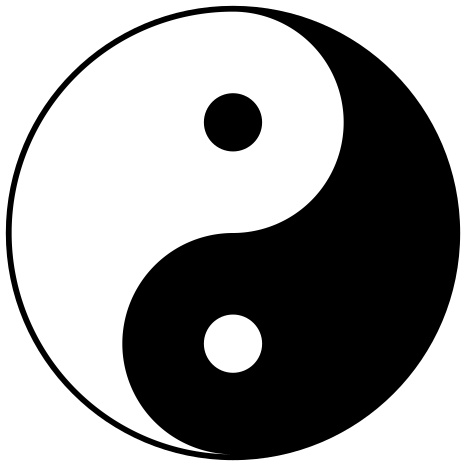
Nothing is static. Every Yang moment carries within it the impulse toward Yin, and every Yin toward Yang. Change is not an exception, it is the universal rule of existence.
Level 2
2 Bits, 4 States: The Four Seasons
What if we stacked two lines? Now we have four possible combinations. The I Ching maps them to the four great cycles of the natural world.
Take your one-bit line and add another below it. Two bits can represent four distinct states: 00, 01, 10, 11. Each pair of lines is called a bigram which corresponds to a phase in nature's perpetual rotation.
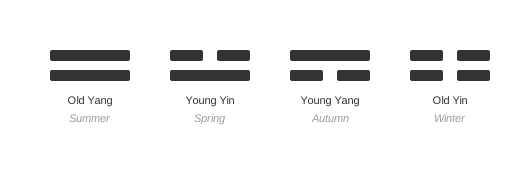
The Four Bigrams: 2-bit binary combinations
Notice the pattern: starting from full Yang (summer: peak activity, heat, expansion), Yin begins to enter. By autumn, Yin is strong in the lower position. By winter, full Yin (stillness, rest, contraction). Then Yang begins its return, and spring arrives. The cycle is complete.
With just two lines and two possible states per line, the I Ching has already encoded the most fundamental rhythm of life on Earth: the annual cycle of transformation. Two bits. Four seasons. An elegant compression of wisdom into symbol.
Level 3
3 Bits, 8 States: The Eight Trigrams
Add one more line, and the world opens up. Eight fundamental forces. Eight archetypes. Eight ways that energy can be arranged in the universe.
Three lines, each either solid or broken, yields 2³ = 8 combinations. These are the trigrams, the true atomic units of the I Ching. The ancient Chinese associated each with a natural force, a direction, a season, a family member, and much more. They are a complete vocabulary of elemental energies.
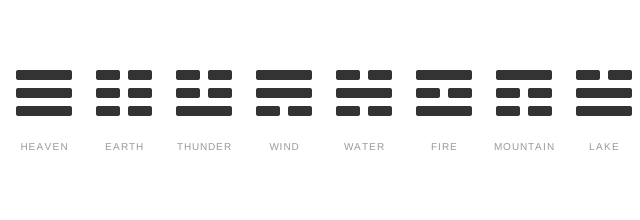
The Eight Trigrams: 3-bit binary combinations
Look at Heaven (☰ three solid lines) pure Yang, undivided creative force. Now look at Earth (☷ three broken lines) pure Yin, pure receptivity. Between them, six more archetypes express every blend of these forces. Thunder (☳) is Yang energy erupting upward. Water (☵) is Yang trapped within Yin, light in the depths. Fire (☲) is Yin at the core of Yang, the hollow within the flame.
These are not just symbols. They are models of how energy behaves. They describe the patterns behind weather, seasons, relationships, political cycles, personal growth. Three bits. Eight archetypes. A complete grammar of natural forces.
The eight trigrams are like the eight notes of a musical scale - limited in number, vast in combination.
Level 4
6 Bits, 64 States: The Hexagram
Now we make the decisive leap by stacking two trigrams. Upper and lower. The energy of one force meeting another. What emerges is a complete picture of a situation in time.
A hexagram is made of six lines: a lower trigram representing the inner world, the foundation, the situation below; and an upper trigram representing the outer world, the environment, what is approaching from above.
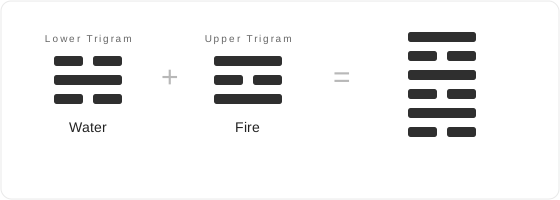
The meaning of a hexagram comes from the conversation between its two trigrams. Fire above Water, these forces oppose each other. Fire rises, Water descends. The image is of incompletion, of two energies pulling apart. The I Ching calls this Hexagram 64: "Before Completion." The situation holds great potential, but the pieces have not yet come together.
Flip them around, Water above Fire, and you get Hexagram 63 "After Completion." Now the energies are aligned - Water descends into the Fire, creating steam, harmony, culmination. The situation has ripened.
Six lines. 2⁶ = 64 possible arrangements. And these 64 hexagrams, the I Ching proposes, describe every situation, every phase of every process, that anything in the cosmos can occupy.
The Complete System: 64 States of Transformation
Everything - every project, relationship, season, civilization, body moves through these 64 stations. Not randomly, in cycles.
View the complete hexagram collection
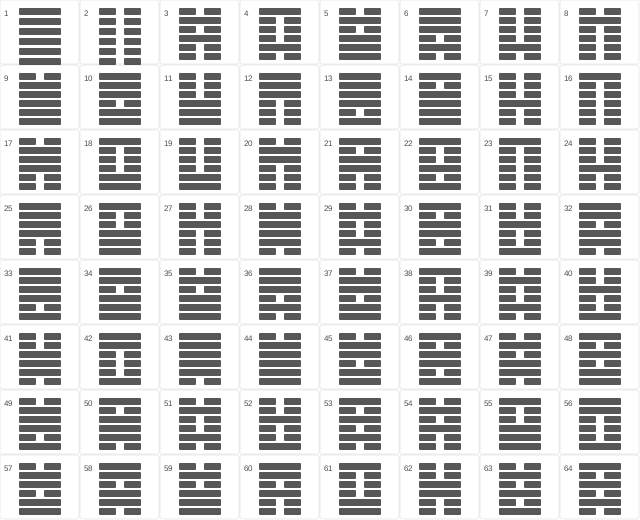
All 64 Hexagrams, the complete Periodic Table of Transformation
The 64 hexagrams are not a random list. They are arranged in a deliberate sequence of paired opposites — each hexagram leading naturally into the next, mirroring how situations in life evolve. Stagnation (hexagram 12) follows Harmony (hexagram 11), because peaks naturally give way to valleys. Not Yet Across (hexagram 64) follows Already Across (hexagram 63), because every completion carries the seed of a new beginning.
This is the deepest insight of the I Ching: nothing is permanent, and nothing is isolated. Every state contains the seed of its own transformation. Every element in this table is connected to every other through the continuous thread of change.
Just as the Periodic Table revealed that matter is not random but structured, that elements follow patterns and fill predictable positions. The 64 hexagrams reveal that change itself has a grammar.
Consider how familiar this feels. A new venture begins with enthusiasm and raw energy (Heaven, pure Yang). It encounters obstacles (Water, Pit). It adapts and spreads (Wind). It finds its power (Thunder). It illuminates and reaches its peak (Fire). It rests in fullness (Lake). It becomes still (Mountain). It returns to receptivity (Earth, pure Yin). And from that stillness, a new impulse is born.
This is the cycle of creation and dissolution. The I Ching maps every variation of it — every nuance of how two forces can meet, cooperate, resist, transform, and give birth to the next phase.
The Shape of the Moment
The I Ching is a tool for understanding the shifting nature of the present moment.
The periodic table gives a chemist a framework for understanding an element they have encountered. It reveals something about how that element behaves, what it is likely to bond with, and what it will resist. It does not describe every reaction in advance. It describes the nature of the element.
The 64 hexagrams serve a related purpose. Each one describes a pattern of change or a type of situation. A hexagram does not explain every detail of your circumstances. It gives you a way to recognize the larger pattern taking shape around you.
Hexagram 34 describes a moment of great force that may need to be restrained. Hexagram 12 describes stagnation and the inward movement that can accompany it. Hexagram 22 describes a moment of beauty while also suggesting that beauty contains the first signs of its own decline.
Recognizing the pattern does not tell you exactly what will happen. It can give you a clearer sense of the direction of travel, which may help you make a better decision within the situation you are facing.
Long before binary code, the I Ching organized patterns of change into a compact combinatorial system. The comparison to the periodic table is an analogy, not an identity. The I Ching is not a scientific instrument. But both systems attempt to make a complex field of possibilities easier to understand by identifying the basic forms that recur within it.